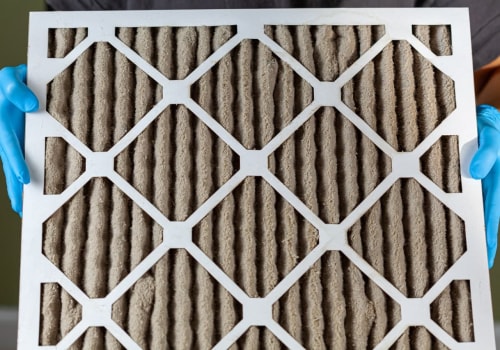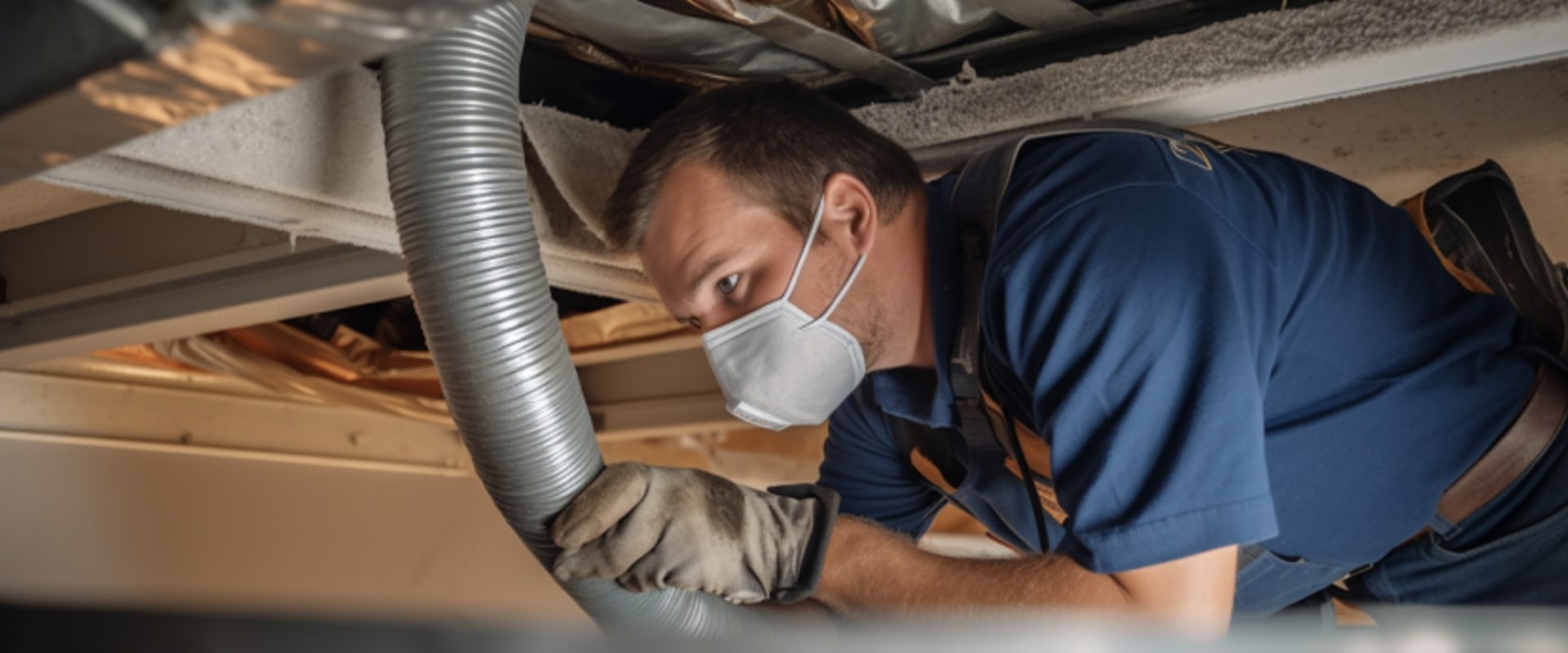
We’ve found a saturated flex duct in Winter Garden attics that hadn’t seen a named storm in years. What got them was a regular July afternoon — two inches of rain in under an hour, a soffit seal that had been slowly giving way, and an attic floor that held the water long enough to reach the duct runs below. Nobody knew there was a problem until the house started smelling different.
Rain damage to ductwork is a slow-build problem. The fiberglass insulation jacket absorbs moisture, the inner liner weakens, and the HVAC system starts moving air through a compromised pathway. By the time musty odors or uneven cooling appear in the living space, the damage has usually been working for weeks.
Our team handles HVAC air ductwork repair in Winter Garden throughout Orange County. In the older neighborhoods west toward Lake Apopka and around Lake Avalon, we see this pattern more often than most homeowners expect.
TL;DR Quick Answers
Air Duct Repair in Winter Garden
Air duct repair in Winter Garden addresses damage to the flex duct systems common in Orange County homes — leaking joints, saturated insulation, collapsed liner sections, and mold caused by Florida's humidity and rain infiltration. Licensed HVAC contractors inspect duct runs using visual assessment and pressure testing, then repair or replace damaged sections based on what the data shows. Costs vary depending on damage extent and attic accessibility. Any contractor performing this work in Florida must hold an active license verifiable at MyFloridaLicense.com.
Top Takeaways
Rain damage to air ducts is a slow-build problem. Moisture from a single roof event can sit in duct insulation for weeks before any symptoms appear in the living space. By that point, mold conditions are often already established.
Flex ducts in older Winter Garden homes is the most vulnerable type. Homes built before 2000 in neighborhoods near Plant Street and Tilden Avenue often have original flex ducts whose fiberglass jacket doesn’t dry quickly in Florida’s year-round humidity.
Mold is the secondary threat that often does more damage than the water itself. Once moisture stays inside a duct run, the HVAC system carries contaminated air to every room it serves, sleeping areas and children’s spaces included.
Not all rain-damaged ductwork requires full replacement. What the inspection finds determines the scope: mastic sealing for small breaches, section replacement for failed liner, full insulation jacket work where only the outer layer is compromised. How long the moisture was present matters most.
Florida DBPR licensing is the verification standard that protects you. Any HVAC contractor doing duct repair in Orange County needs an active Florida license. Confirm the number at MyFloridaLicense.com before anything starts.
How Winter Garden’s Rain Season Puts Ductwork at Risk
Orange County sits inside Central Florida’s wet season corridor. From June through September, afternoon storms roll through almost daily, with the area regularly recording seven or more inches of rain per month at peak. The lower-elevation neighborhoods around Lake Apopka and western Winter Garden hold water longer after a heavy event than most people realize.
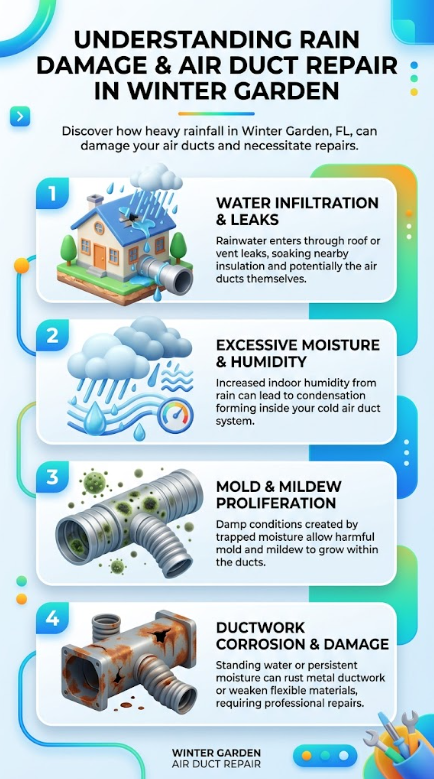
Attics absorb the consequences. When a soffit seal fails, a ridge vent takes on water, or roof flashing around a chimney or HVAC stack shifts over a summer storm cycle, water gets into the attic before anyone notices. That water doesn’t stay on the decking. It travels — along joists, across insulation batts, and down toward the duct runs suspended or laid across the attic floor.
Homes built in Winter Garden before roughly 2000 are the most common cases we see for this kind of damage. The original flex duct from that era has a fiberglass insulation jacket that absorbs water readily. Once wet, that jacket doesn’t dry the way it would in a drier climate. It stays saturated for weeks, and the damage works inward from there.
The Failure Chain — From Roof Leak to Duct Damage
In our inspections, the failure almost always starts the same way. A minor roof breach or failing soffit lets water into the attic. Not a dramatic flood — just enough to matter. That water contacts the outer insulation jacket of a flex duct run, and the fiberglass absorbs it. Florida’s ambient humidity blocks the evaporation that would clear it somewhere drier, so the moisture sits. After days or weeks, it works its way to the inner plastic liner. That liner develops micro-tears, begins to sag, and eventually collapses under the weight of saturated insulation pressing down on it.
At that point, conditioned air from your HVAC system is no longer moving through a sealed pathway. It’s leaking into the attic, and the attic’s unconditioned air (dust, mold spores, pest debris) is getting drawn back in. Through any return-side breach, the system pulls from that contaminated zone and pushes it to every room in the house.
What determines the repair scope is how long the moisture was present before we got there. Short-duration saturation with no active mold, identified by a musty odor and insulation discoloration, usually supports repair: mastic sealant on small breaches, section replacement on damaged flex runs, insulation jacket work where the liner is still intact. Longer-duration moisture with visible mold growth or liner collapse is a different situation. Replacing the affected duct runs is the right call in those cases.
Warning Signs Homeowners Can Spot
Rain-damaged ductwork doesn’t announce itself the way a burst pipe does. Signs build gradually, and most homeowners never connect them to a storm that passed a month earlier. Here’s what we’ve learned to watch for in these inspections, and what each signal typically points to:
A musty or earthy odor from registers within a day or two of a heavy rain event. That smell is mold already active, not just humidity.
Rooms that previously cooled well now show weak output at the register, especially on upper floors or at the far end of a duct run from the air handler.
Water staining or discoloration on drywall near ceiling duct runs, particularly on walls backing against an attic space or roofline.
A Duke Energy or OUC bill that climbs without any change in usage pattern. Compromised duct runs lose conditioned air into the attic, and the system runs longer to make up for it.
Worsening indoor allergy or respiratory symptoms: sneezing, eye irritation, or congestion that clears up after you leave the house. When symptoms consistently improve outdoors and return indoors, mold spore circulation through the duct system is worth investigating.
What HVAC Air Duct Repair Involves
When our technicians inspect a home for rain-related duct damage, they start with a visual and pressure inspection that maps where damage is and how far it’s spread. NADCA inspection standards guide that process: collapsed liner sections, saturated insulation, disconnected joints, evidence of active mold. Everything gets documented before any repair decision is made.
The repair scope follows what the inspection finds. Mastic sealant handles small breaches and joint separations where the liner is still structurally sound. Section replacement is appropriate when the liner has failed or the insulation jacket is saturated past the point of drying. Full insulation jacket work restores thermal performance when the liner is intact but the outer wrap is compromised. Widespread mold or structural collapse across multiple runs means replacing those duct sections, and that call comes from the data, not a default assumption.
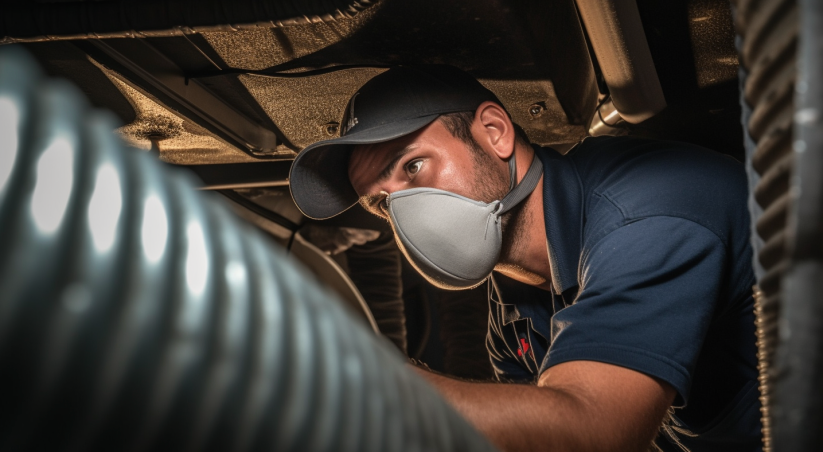
"After years of inspecting ductwork in Central Florida, the pattern I've come to expect from a rain event is one saturated duct run surrounded by perfectly dry ones — the water finds the low point in the attic and pools there. That's why a visual check alone misses it almost every time, and why the pressure test is the piece of the inspection that can't be skipped."
Essential Resources
1. Florida DBPR Contractor License Verification
The Florida Department of Business and Professional Regulation maintains the state’s active contractor license database. Before authorizing any HVAC repair work in Orange County, run your contractor’s license number here to confirm active standing.
Source: MyFloridaLicense.com
2. NADCA: National Air Duct Cleaners Association
NADCA sets the professional standard for duct system inspection, assessment, and remediation. NADCA-certified technicians follow a documented inspection protocol covering how damage is identified, documented, and repaired. That protocol is what you should expect from any contractor you hire.
Source: NADCA.com
3. U.S. EPA: Mold and Moisture in Your Home
The EPA’s foundational resource on mold prevention, moisture control, and residential remediation standards. If you’re dealing with rain-damaged ductwork and suspect mold growth, start here to understand the health implications and what proper remediation looks like.
Source: epa.gov/mold/brief-guide-mold-moisture-and-your-home
4. ENERGY STAR: Duct Sealing
ENERGY STAR’s homeowner-facing guidance on duct efficiency covers how leakage affects energy performance and what a properly sealed system should deliver. Useful context for understanding what repair success actually looks like in measurable terms.
Source: energystar.gov/saveathome/heating-cooling/duct-sealing
5. University of Florida IFAS Extension: Energy Efficient Homes — The Duct System
A Florida-specific technical resource from UF’s Institute of Food and Agricultural Sciences covering duct leakage mechanics, energy loss, and the compounding effects of moisture and air quality issues particular to Florida’s climate. Directly relevant to the conditions we work with in Orange County.
Source: edis.ifas.ufl.edu/publication/FY1024
6. U.S. EPA: Indoor Air Quality
The EPA’s central resource on indoor air pollutants, including biological agents like mold that can enter conditioned air through damaged ductwork. If respiratory symptoms are part of what you’re experiencing, this is where to understand the connection.
Source: epa.gov/indoor-air-quality-iaq
7. Wikipedia: Winter Garden, Florida
Geographic and community context for Winter Garden: its location in Orange County, its history as a former citrus hub, and the residential development patterns that shape the housing stock our technicians work in every day.
Source: en.wikipedia.org/wiki/Winter_Garden,_Florida
Supporting Statistics
20–30% of conditioned air in a typical home is lost through duct leaks, holes, and poorly connected joints before it ever reaches the rooms it’s meant to serve.
Source: ENERGY STAR Duct Sealing, U.S. Environmental Protection Agency
50% harder. When ducts leak just 20% of conditioned airflow, the HVAC system has to work 50% harder to compensate, driving energy consumption and mechanical wear well beyond what a properly sealed system would require.
Source: University of Florida IFAS Extension — Energy Efficient Homes: The Duct System
24–48 hours. The U.S. EPA states that wet or damp building materials must be dried within this window to prevent mold growth. For Florida homes, attic moisture that reaches duct insulation during a summer storm has a very short recovery window before mold conditions are established.
Source: U.S. EPA — A Brief Guide to Mold, Moisture, and Your Home
Final Thoughts
Working in Winter Garden homes, we’ve found that rain damage to ductwork gets underestimated. The damage just doesn’t look like much. A subtle change in smell from a vent. A room that stopped cooling right. By the time those signals appear, the moisture event that caused them has usually passed weeks ago.
That gap between cause and symptom is where the damage compounds. Our recommendation: if your home took a significant rain event and you’ve noticed even one item from the warning-signs list above, get an inspection. It either confirms your system is fine (the best possible outcome) or it catches damage before it becomes a mold remediation job. Either way, waiting makes it worse.
Frequently Asked Questions
Does homeowners insurance cover rain-damaged air ducts in Winter Garden?
Standard homeowners insurance policies generally don’t cover duct damage from gradual moisture buildup or normal wear. Coverage becomes more likely when damage traces back to a specific sudden event: a named storm, a wind-caused roof breach, or documented flooding your policy covers. Before filing a claim, document the storm date and any visible attic or roof damage, and get the technician’s written findings in hand.
How long does HVAC air duct repair take in a typical Winter Garden home?
Most targeted duct repairs are completed in a single visit, three to six hours for an average-sized home. That covers mastic sealing, section replacement, and insulation jacket work on the affected runs. Widespread damage or full system replacement typically takes a full day. Your technician will give you a time estimate based on what the inspection finds, before any work starts.
Can I run my HVAC system while waiting for duct repair?
If mold growth is suspected, running the system isn’t a good idea. A damaged duct run drawing air from a moisture-contaminated attic will push that air through every room with each cooling cycle. While waiting on a repair appointment, keep runtime to a minimum and use windows and fans for ventilation until the work is done.
How do I tell if my duct damage is from rain versus normal age-related wear?
Rain damage shows up in localized duct runs — the sections nearest a roof breach, soffit failure, or low-drainage attic area — rather than uniformly across the system. Age-related wear spreads more evenly, especially at joints and flex duct bends. A licensed inspector can tell the difference through a pressure test and visual assessment, and the inspection report should specify which failure mode applies.
Is mold in ductwork from rain damage dangerous?
Mold spores moving through a forced-air HVAC system reach every room it serves. For anyone with asthma, allergies, or a compromised immune system, that can mean respiratory symptoms, eye and throat irritation, and worsening allergy responses over time. The EPA treats mold-contaminated building materials as a remediation priority, not a deferred maintenance item. That standard applies to ductwork. Get the scope confirmed through professional inspection before making the repair-versus-replacement call.
Protect Your Home From Rain Damage That Causes Air Duct Repair Costs in Winter Garden
Rain damage to your duct system compounds quietly — the longer it goes unaddressed, the more expensive the repair becomes. Schedule an inspection with our licensed Winter Garden team and find out exactly what your ductwork is dealing with.
Here is the nearest branch location serving the Doral FL area…
Filterbuy HVAC Solutions - Miami FL
1300 S Miami Ave Unit 4806, Miami, FL 33130
(305) 306-5027